
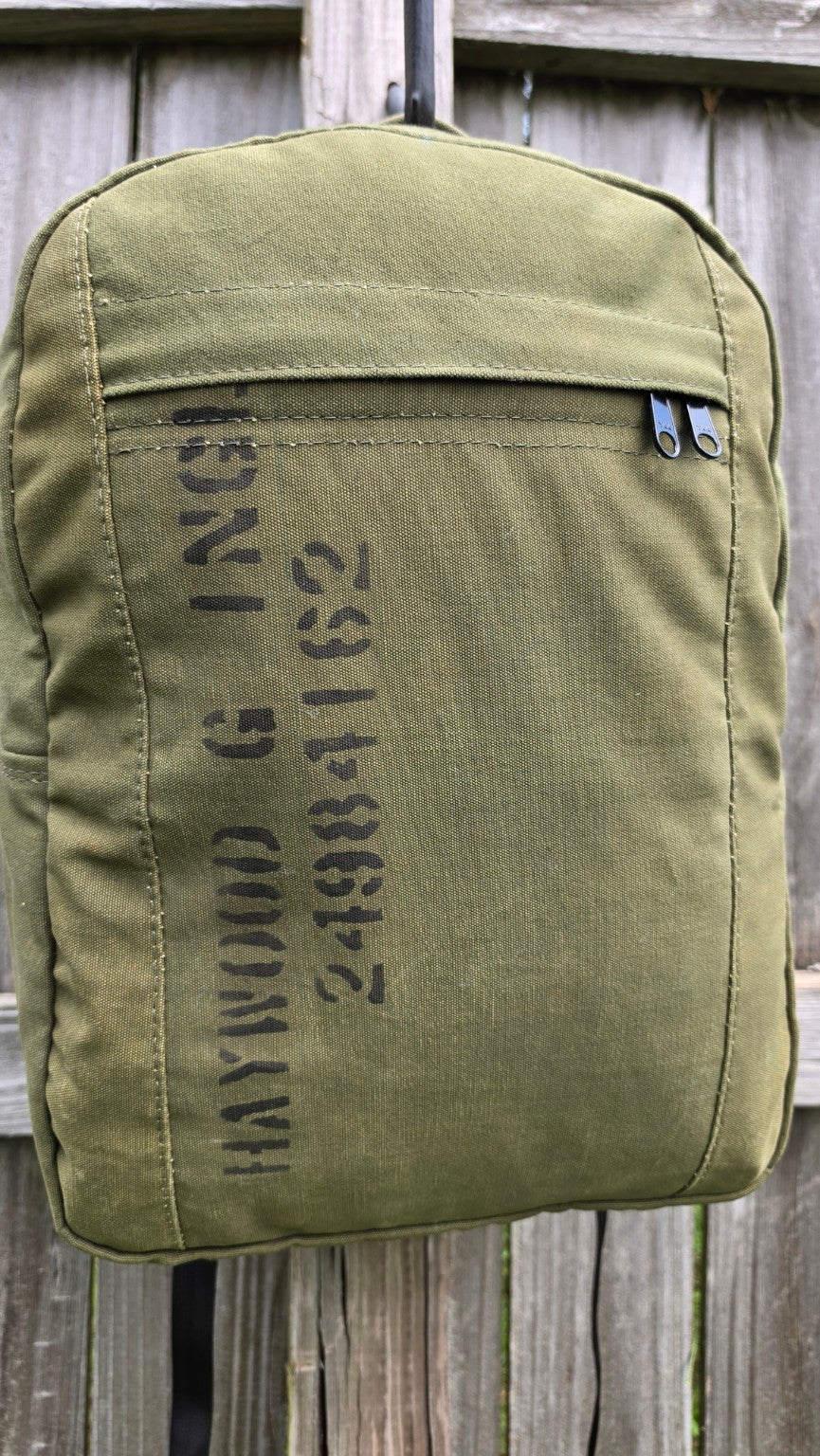
Two military duffel bags. Decades of history. One Heritage build.
Every military surplus bag has a history. Most of that history is lost long before the bag reaches our workbench.
Sometimes something remains: a faded stencil, a service number, or a name written across the canvas. On this bag, that name was HAYWOOD G. INGLE.
A Name Worth Researching

One of the surplus duffels used in this build was recorded in our research as a 1952 bag. On its side was the name HAYWOOD G. INGLE, accompanied by the number 24984162. These are markings on the artifact itself—not a service-number match independently obtained from military personnel records.

At UTG, we try to learn something about the people associated with the original materials whenever the surviving evidence allows. Names can lead to real stories. But they can also lead to people who simply share a name, and we believe the difference matters.
A Possible Connection in North Carolina
Research led us to Haywood Graham Ingle of Burlington, North Carolina. According to his published obituary, he was born January 20, 1934, in Alamance County and died January 17, 2018, aged 83. He was a U.S. Army veteran, a former American Legion member, and retired from AT&T following 37 years of service. He also belonged to Shallow Ford Christian Church.
A remembrance shared on his obituary page recalls his Army service in Germany. It tells of a letter promising to bring someone at home “fried snowballs,” followed by a playful return home with a cup of water. It is a personal recollection, not an official service record—but exactly the sort of detail that helps a name on a page feel human.
Important research distinction: We have not independently verified that Haywood Graham Ingle of Burlington was the individual whose name was stenciled on this specific bag. His name and Army service make him a possible match, not a confirmed identification. We also cannot establish where this particular duffel traveled or what it carried.
Two Duffels. Two Eras.
The Heritage Haywood build combined material from two separate U.S. military duffels: one dated 1944 and one dated 1952. The first comes from the World War II period; the second from the Korean War era. Those are dates for the source bags, not proof that either was carried in a particular conflict.

Using the UTG Mk1 Slim pattern as the foundation, we repurposed the old canvas into a practical backpack. The goal was not to make the material look factory-new. The fading, signs of use, and original name are what make this build different from an ordinary production bag.
History That Keeps Working
Military surplus is sometimes treated as little more than inexpensive raw material. We see something else: fabric once issued, packed, handled, and eventually set aside. Not every owner can be identified, and not every story can be recovered. What survives deserves careful treatment.
The finished UTG Mk1S Heritage: Haywood gives this vintage canvas a new purpose without pretending its past is fully known.
The material gets a new mission. The history comes along with it.
Research Notes & Sources
- Artifact-supported: Original duffel photographs document the HAYWOOD G. INGLE name, number 24984162, and construction details. See UTG's U.S. Military Duffel Bag Visual-Reference Edition 4.0, marking-orientation plate.
- Documented biography: Lowe Funeral Home obituary for Haywood Graham Ingle.
- Personal recollection: The Times-News obituary and public remembrances, including the recollection of military service in Germany.
- Unconfirmed: The link between the physical duffel and the man identified in the obituary. We have not confirmed a matching Army service record.
We welcome additional documented information that may help verify the provenance of this original military duffel.